Pharmacovigilance in the Age of Data: Why the Job Market Is Crying Out for Pharma Professionals Who Can Analyse
You spent years studying pharmacology, drug interactions, adverse event reporting, and regulatory compliance. You know medicines — how they work, how they're monitored, and what happens when something goes wrong.
But here's a question worth sitting with: Is your career keeping pace with how the pharma industry is evolving? Because right now, one of the fastest-growing intersections in the global job market sits right at the crossroads of your existing expertise and one powerful new skill set — data analytics.
And most pharma professionals don't even know the opportunity exists.
What Is Pharmacovigilance, and Why Does It Need Data?
Pharmacovigilance (PV) is the science of detecting, assessing, and preventing adverse effects of medicines. It's a critical function in every pharmaceutical company, regulatory body, and healthcare organisation worldwide.
Traditionally, PV has been a manual, document-heavy process — reviewing Individual Case Safety Reports (ICSRs), submitting Periodic Safety Update Reports (PSURs), and tracking signals through databases like VigiBase, FAERS, and EudraVigilance.
But the volume of data being generated has exploded.
Millions of adverse event reports. Social media signals. Electronic health records. Real-world evidence from wearables and patient apps. Clinical trial data from multiple sites across continents.
No human team — no matter how experienced — can manually process this volume of information fast enough to keep patients safe and regulators satisfied.
That's where data analytics comes in.
Choosing the Right Blogging Platform
Global regulators including the FDA, EMA, and TGA are actively pushing for data-driven pharmacovigilance. They want smarter signal detection, faster safety reporting, and more robust risk management — all powered by technology.
The result? A surge in demand for professionals who sit at the intersection of pharma knowledge and data skills.
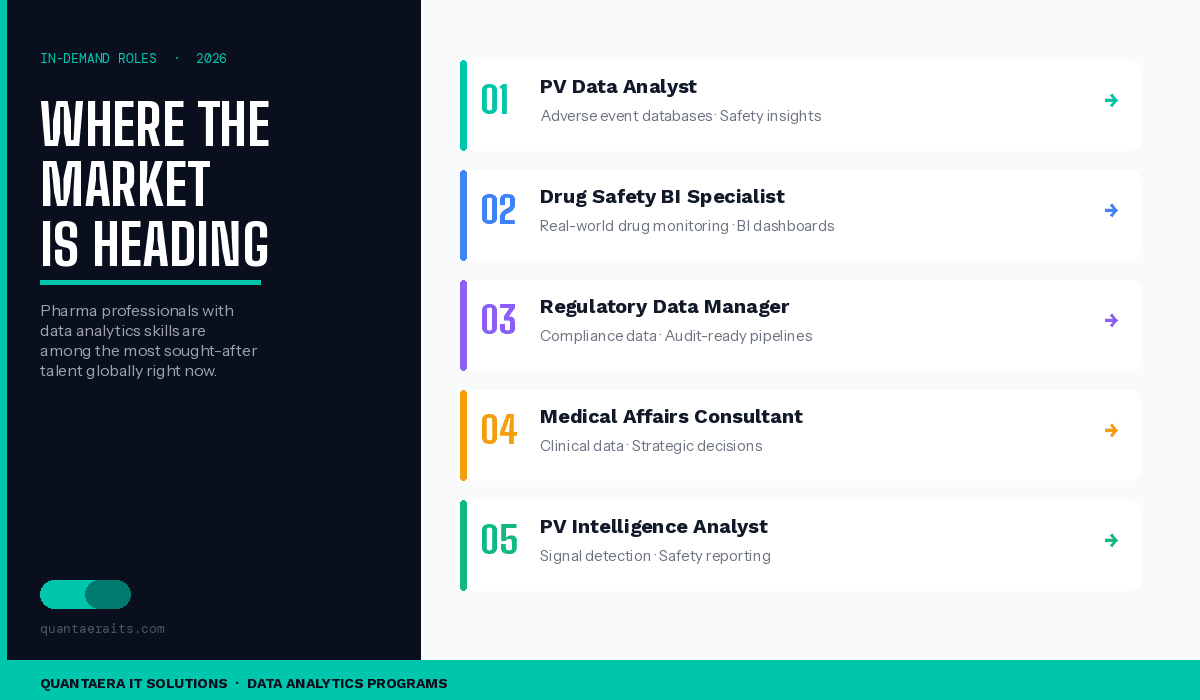
Job titles that are growing rapidly right now include:
- PV Data Analyst: analysing adverse event databases and generating safety insights
- Drug Safety Intelligence Analyst: using BI tools to monitor real-world drug performance
- Pharmacovigilance BI Specialist: building dashboards to track safety signals and reporting timelines
- Regulatory Data Manager: ensuring compliance data is structured, clean, and audit-ready
- Medical Affairs Data Consultant: translating clinical data into strategic business decisions
These roles are being advertised across India, Australia, the UK, the US, and the Middle East — and they're commanding strong salaries precisely because the talent pool is so small.
The pharma industry knows drugs. It's desperately looking for people who also know data.
Why Pharma Professionals Have a Hidden Advantage
Here's what the job market understands that many pharma professionals don't yet see in themselves:
Domain knowledge is irreplaceable.
A data analyst hired from outside the industry can learn Power BI in weeks. But learning how an Individual Case Safety Report works, understanding MedDRA coding, knowing why a signal threshold matters, or grasping the difference between a Type A and Type B adverse reaction takes years.
Pharma and healthcare professionals already have that foundation. They just need to add the analytical layer on top.
That combination of deep domain knowledge plus data skills is exactly what employers are willing to pay a premium for. It's not an either/or. It's a multiplier.

What Data Skills Does a PV Professional Actually Need?
You don't need to become a software engineer. You don't need to learn Python (though it helps). What the market is asking for right now is surprisingly accessible:
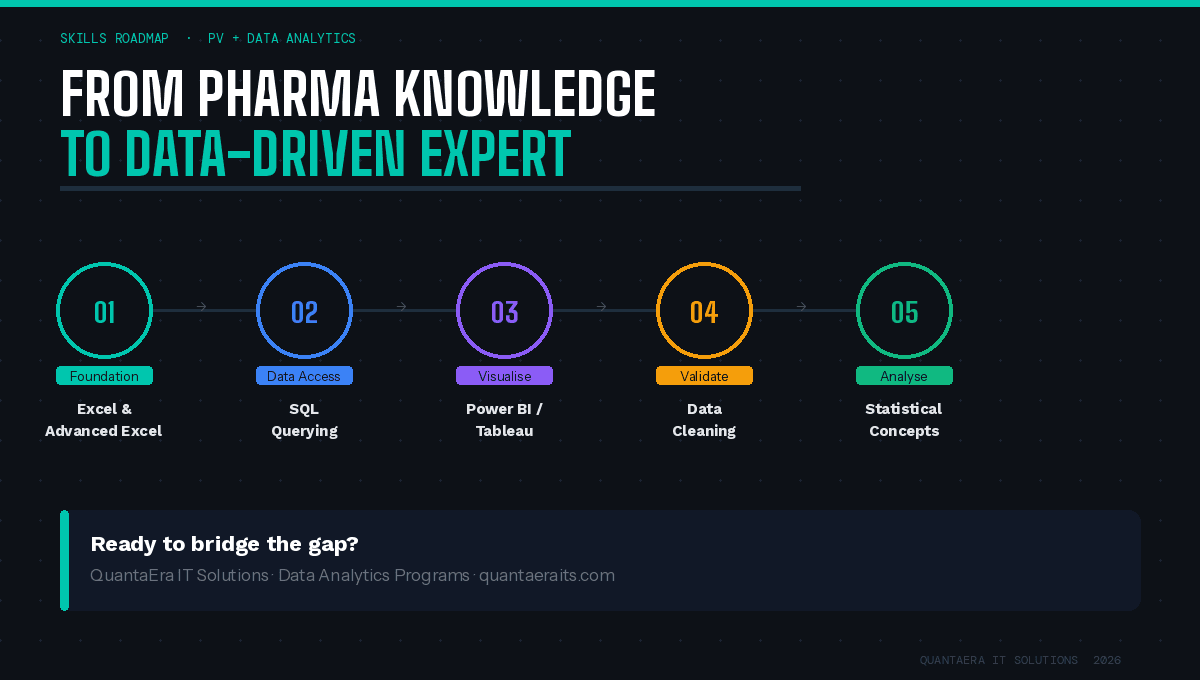
Excel & Advanced Excel: Still the backbone of most pharma data workflows. Pivot tables, VLOOKUP, Power Query, and data validation are essential starting points.
SQL: The language of databases. If your adverse event data lives in a structured database — and it does — SQL lets you query it, filter it, and extract exactly what you need. A foundational skill for any PV data role.
Power BI or Tableau: These tools transform your safety data into visual dashboards that compliance teams, medical directors, and regulators can actually understand at a glance. Signal tracking. ICSR volumes by quarter. Time-to-report metrics. All of it, live and interactive.
Data Cleaning & Validation: Knowing how to identify inconsistencies, handle missing data, and ensure data integrity — critical in a regulatory environment where data quality is everything.
Basic Statistical Concepts: Understanding reporting odds ratios (ROR), proportional reporting ratios (PRR), and disproportionality analysis — the statistical backbone of signal detection in pharmacovigilance.
Where Do You Start?
If you're a pharmacist, drug safety associate, regulatory affairs professional, or healthcare worker reading this, here's a simple starting point:
- Assess your current data skills: Can you build a pivot table? Write a basic SQL query? If not, that's where you begin.
- Get familiar with the tools: Power BI and Excel are the most immediately valuable for PV roles. Start there.
- Learn in context: Don't just take a generic data course. Seek out training that connects data skills to real pharma and healthcare use cases.
- Build a portfolio: Create sample dashboards using public adverse event databases like FAERS. Show employers you can apply the skills, not just talk about them.
- Update your positioning: Your LinkedIn, your CV, your professional narrative start framing yourself as a data-capable pharma professional. That positioning alone opens new doors.
The Bottom Line
Pharmacovigilance has always been about protecting patients. Data analytics makes that mission faster, smarter, and more scalable than ever before.
The job market has already figured this out. Employers are creating roles, budgeting for talent, and searching — often without success — for professionals who can bridge both worlds.
The opportunity is real. The demand is now. And you — with your pharma background and the right data skills — are exactly who the industry is looking for.
The only question is whether you'll be ready when they come looking.
At QuantaEra IT Solutions, we work with pharma and healthcare professionals to build the data analytics skills that make them job-ready in this evolving landscape. Explore our Pharmacovigilance Programs and take the first step toward the career your expertise deserves.