
The Semantic Layer: Why the Next Big Thing in BI Isn't a Tool — It's an Architecture
Every few years, something shifts in the world of Business Intelligence that looks minor on the surface but turns out to reshape everything underneath.
The move from spreadsheets to dashboards was one. The shift to cloud data warehouses was another. And now, quietly but unmistakably, the semantic layer is becoming the next foundational shift in how organisations think about, manage, and trust their data.
It's not a new BI tool. It's not another dashboard platform. It's not even a feature you click to enable. It's an architectural decision — one that determines whether your entire data ecosystem becomes more trustworthy and scalable, or continues to fracture under the weight of its own inconsistency.
Here's what it is, why it matters, and why every data professional needs to understand it right now.
The Problem It Solves (And Why It's Bigger Than You Think)
Before explaining what a semantic layer is, it helps to understand the problem that made it necessary.
Picture a mid-sized company with three departments — sales, finance, and marketing. All three use different BI tools or different reports to track "revenue." But here's the problem: they're each calculating it differently. Sales counts a deal as revenue when it's signed. Finance counts it when it's invoiced. Marketing counts it when the lead converts.
When someone asks "why did revenue change?", the answer depends entirely on which definition you're using — gross revenue, net revenue, recognised revenue, or bookings. Without documented disambiguation rules in place, every query returns a different answer.
Now multiply that single metric across an entire organisation — hundreds of KPIs, dozens of teams, multiple BI tools, and several data platforms — and you start to see the scale of the problem. Meetings derail because two teams are looking at the same metric and getting different numbers. Decisions are delayed while analysts spend hours reconciling reports. Trust in data erodes — and once it erodes, it's genuinely hard to rebuild.

For the past decade, enterprises treated this as a BI maintenance problem. Different definitions of "revenue" across Tableau and Power BI? Write some documentation. Metrics drifting between dashboards? Schedule quarterly reconciliation meetings. This approach worked when humans were consuming the analytics — they could spot obvious errors and apply business context to questionable numbers.
Then generative AI arrived. And it broke this model completely.
Why AI Made the Semantic Layer Urgent
AI doesn't apply business context. It doesn't notice that your Q3 revenue figure looks suspicious because the finance team changed their calculation methodology in August. It doesn't flag that the "customer count" in one dashboard excludes trial users while another doesn't.
AI takes the data as given — and if the data is inconsistently defined, AI doesn't just surface that inconsistency. It scales it, automates it, and embeds it into every output it generates.
2025 was the year semantics moved from "nice-to-have" to "foundational infrastructure" — not driven by vendor messaging or analyst hype, but forced by enterprises attempting to deploy AI at production scale.
BI sprawl already made metric drift expensive. AI makes it easier to spread that drift faster. And when an AI copilot confidently presents a board-level insight built on an inconsistently defined metric, the damage to trust — in both the AI and the underlying data — is severe.
The semantic layer is the fix. It's what makes AI-powered analytics trustworthy rather than dangerous.
So What Exactly Is a Semantic Layer?
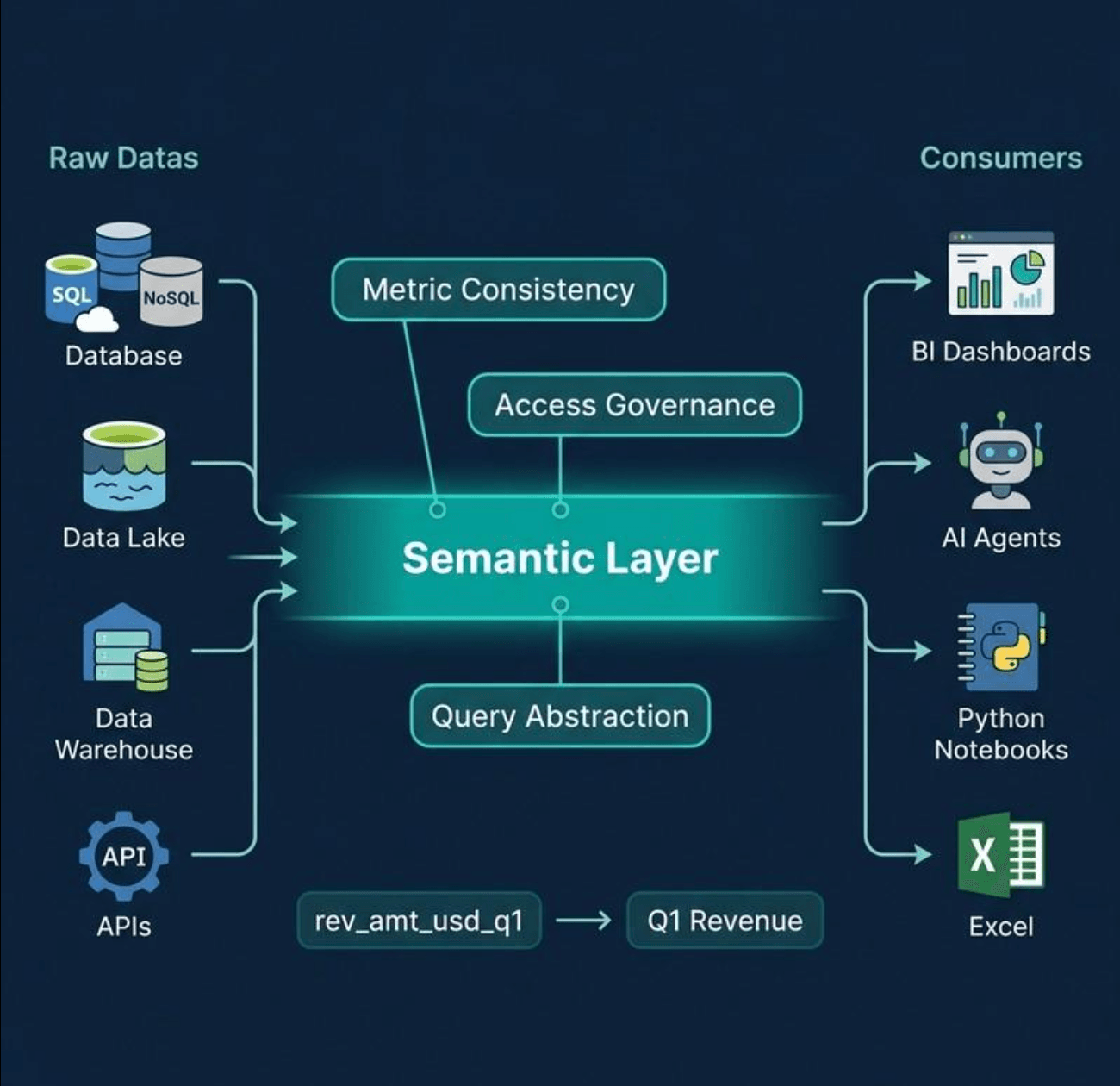
In plain terms: a semantic layer is a governed business model that defines metrics, dimensions, joins, grain, and permissions above raw data. It matters because BI and AI both become unreliable when every dashboard, analyst, or copilot defines business logic differently.
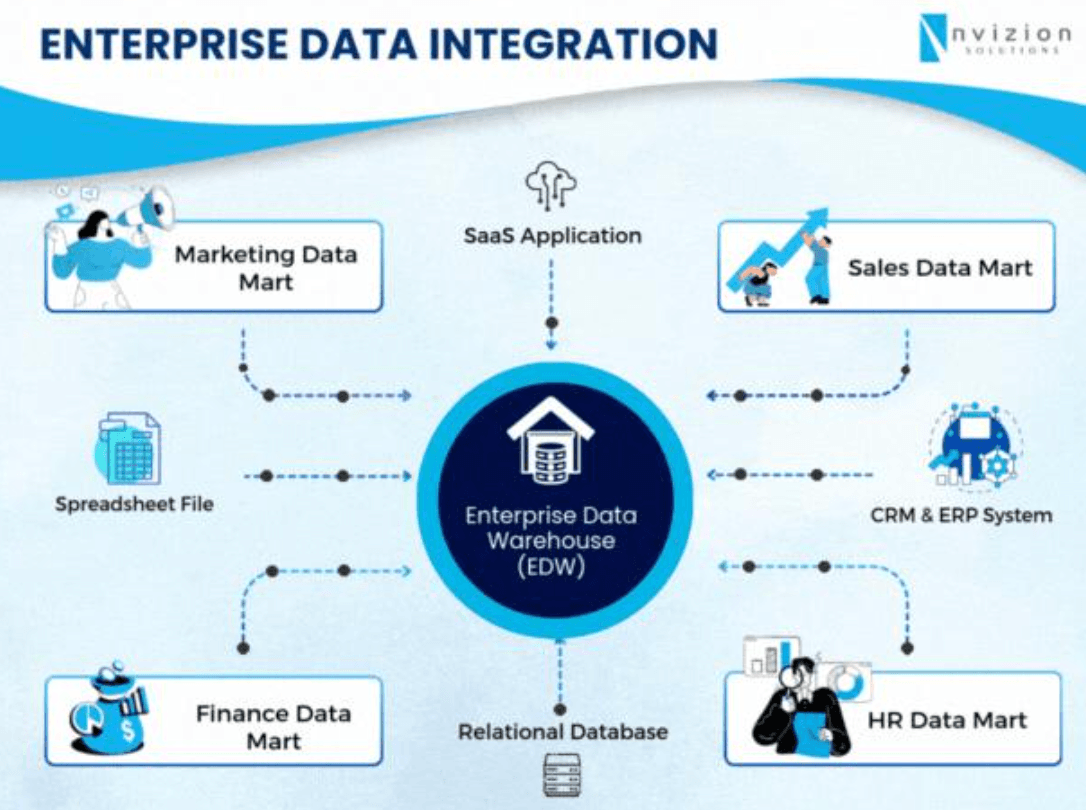
Think of it as a single source of truth — not for the data itself, but for what the data means. It sits between your data warehouse and every tool or person consuming that data, and it answers the question: "When we say 'revenue,' what do we actually mean?"
Define it once in the semantic layer, and that definition flows consistently to every dashboard, every AI query, every embedded analytics tool, and every downstream report. Change it once, and it updates everywhere simultaneously.
No more reconciliation meetings. No more mismatched KPIs. No more "which number is right?"
The Three Architectural Patterns in 2026
Organisations implementing semantic layers in 2026 are choosing among three architectural patterns, each with distinct strengths and limitations.</cite>
Pattern 1: BI-Native Semantic Layers
This is the most familiar pattern. BI-native approaches embed semantic definitions directly within business intelligence tools. Looker implements this through LookML, Power BI uses DAX and its Tabular semantic model, and Tableau introduced Tableau Semantics with shared semantic objects. The strength lies in tight integration with visualisation capabilities — teams using a single dominant BI tool can build semantic models quickly without introducing additional infrastructure.
The limitation? If you use more than one BI tool — and most organisations do — your semantic definitions stay locked inside each tool separately. The inconsistency problem doesn't disappear; it just moves one layer deeper.
Pattern 2: Platform-Native Semantic Layers
Snowflake launched Semantic Views and Cortex Analyst as core components of Snowflake Intelligence in November 2025, enabling natural language querying over semantically defined data. Databricks offers Metric Views through Unity Catalog. These warehouse-native approaches define semantics at the data platform level, making them available to any tool connecting to that warehouse.
This works beautifully when your organisation is committed to a single cloud data platform. It becomes complicated when you're operating across multiple clouds or platforms.
Pattern 3: Universal / Headless Semantic Layers
This is the most ambitious and fastest-growing pattern. Tools like dbt Semantic Layer (powered by MetricFlow), Cube Cloud, and AtScale sit independently of any specific BI tool or data platform — acting as a central, warehouse-agnostic hub for all metric definitions.
dbt Labs open-sourced MetricFlow under an Apache 2.0 licence and co-published the Open Semantic Interchange (OSI) specification alongside Snowflake, Databricks, and Salesforce — a cross-vendor standard for semantic model interchange that signals the industry moving toward genuine interoperability.
For organisations with multi-BI environments, multi-cloud strategies, or serious AI ambitions, the headless approach is increasingly the architecture of choice.
The Market Confirms the Shift
This isn't theoretical. The investment flowing into semantic layer infrastructure tells its own story.
The semantic layer market is projected to expand from $2.71 billion in 2025 to $7.73 billion by 2030; a 23.3% compound annual growth rate. That's not the growth rate of a niche tool. That's the growth rate of foundational infrastructure.
As of 2026, every major BI vendor claims to offer "semantics," "ontology," or an "AI-ready knowledge layer" — which means the concept has crossed the chasm from early adopter territory into mainstream enterprise consideration. When every vendor claims it, the underlying need is real.
The Semantic Layer and the Future of AI in Analytics
The most forward-looking dimension of this shift is what semantic layers make possible for AI — specifically for the wave of autonomous AI agents now entering enterprise analytics.
A breakthrough development in 2025 was the rapid adoption of Anthropic's Model Context Protocol (MCP) — an open standard that enables AI agents to query semantic definitions directly from governed models. By creating a standardised interface between AI systems and semantic layers, MCP introduces traceability, auditability, and consistency into AI workflows. In testing by Twilio, MCP increased task success rates from 92.3% to 100% while reducing compute costs by up to 30%.
Three architectural patterns are emerging for semantic-first AI: Semantic-First AI Agents that reason directly over governed models; Semantic Observability for real-time monitoring of how AI systems interpret business logic; and Composable Governance that treats semantic models as version-controlled, shared code with full lineage and auditability across teams and platforms.
Put simply: the semantic layer is becoming the control plane for enterprise AI. The enterprises that succeed in the next decade won't be those deploying the most AI models. They'll be the ones whose models operate from a common, open, governed semantic foundation.
What This Means for Data Professionals
If you're a data analyst, BI developer, or analytics engineer, the semantic layer shift has direct implications for your career and your daily work.
Metric governance is becoming a core skill. The ability to define, document, and maintain a metric catalogue — knowing what each KPI means, how it's calculated, who owns it, and how it should behave under different filters — is rapidly becoming one of the most valuable capabilities a data professional can have.
dbt is becoming foundational literacy. The dbt Semantic Layer and MetricFlow are fast becoming industry standards. If you haven't explored dbt yet, 2026 is the year to start.
Understanding architecture matters more than knowing tools. The professionals who will lead data teams over the next decade aren't just people who know Power BI or Tableau. They're people who understand how data flows through an organisation — from warehouse to semantic layer to BI tool to AI agent — and can make architectural decisions that keep that flow trustworthy and scalable.
The "define once, use everywhere" principle is the north star. Whatever tools or platforms your organisation uses, the goal is the same: define business logic in one governed place and make it available consistently everywhere. That mindset — more than any specific certification or tool — is what separates the analysts of today from the data architects of tomorrow.
The Bottom Line
The semantic layer isn't the most glamorous topic in Business Intelligence. It doesn't have a flashy UI or a viral demo. It doesn't produce a chart that wows a boardroom in seconds.
What it produces is something far more valuable: trust. Trust that when your CEO looks at the revenue figure in the board deck, it's the same number your sales director sees in their dashboard, your finance team used in their forecast, and your AI copilot queried this morning.
In a world drowning in data, trust is the scarcest resource. The semantic layer is how you build it — systematically, durably, and at scale.
And that's why it's not just the next big tool in BI. It's the next big idea.
At QuantaEra IT Solutions, we train data professionals to think beyond tools — to understand the architectures, frameworks, and principles that make data work reliably in the real world. Explore our Data Analytics Programs and build skills that go deeper than the dashboard.